Confirmation Bias
We seek what confirms. We ignore what contradicts.
Definition
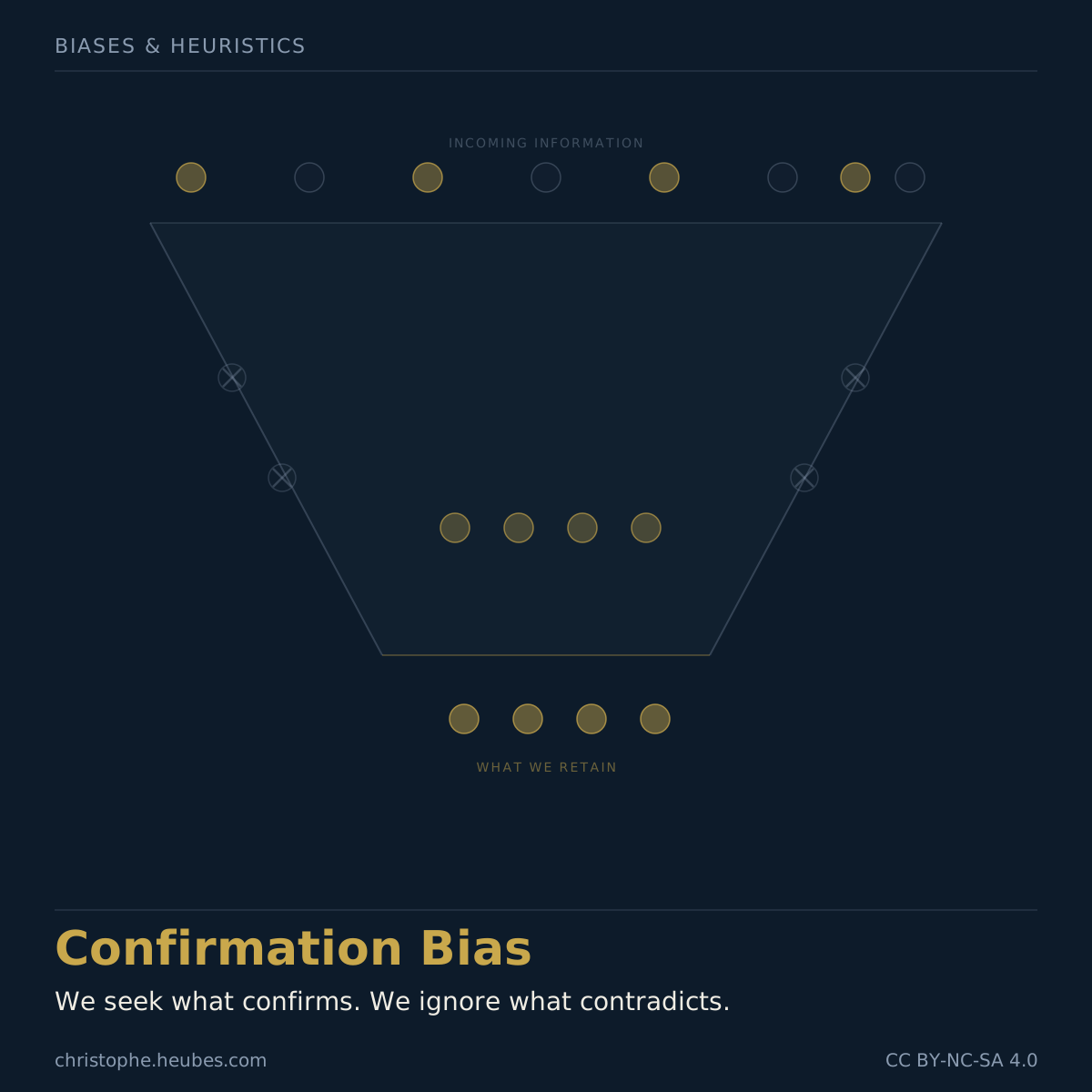
Confirmation bias is one of the most universal and well-documented cognitive errors. It refers to the tendency to search for, interpret, remember, and favour information that confirms pre-existing beliefs or hypotheses, while paying less attention to, or rejecting, information that contradicts them.
This bias is not merely passive (ignoring contrary information): it is often active. We build our sources, networks, and reading to maximise confirmation. We ask questions whose form induces the desired answer.
Why it matters
Confirmation bias profoundly affects the quality of decisions:
In diagnostic medicine: once a doctor has a hypothesis, they tend to look for signs that confirm it and minimise those that contradict it. This is one of the main sources of diagnostic errors.
In science: researchers can, consciously or unconsciously, collect data, analyse results, or write conclusions in ways that confirm their initial hypothesis. Replication and peer review exist partly to counterbalance this bias.
In management: a leader convinced of a strategy will naturally interpret ambiguous data as confirmations, and explain contrary signals as “exceptions”.
In political and social debates: recommendation algorithms amplify confirmation bias by creating “filter bubbles”, we only see what already reinforces our opinions.
Concrete examples
The convinced investor: persuaded that a stock will rise, they read favourable analyses, ignore warnings, and reinterpret every downward movement as a “temporary correction”.
Recruitment: a recruiter who has a good impression in the first few minutes unconsciously seeks to confirm that judgement, interpreting ambiguous answers positively.
Conspiracy theories: they are structurally impervious to contradiction, any contrary evidence is reinterpreted as further proof of the conspiracy. Confirmation bias is the fuel of closed belief systems.
Decision meetings: an idea presented by a powerful leader will be confirmed by participants, who select supporting arguments and suppress objections.
Counter-measures: actively seek contrary evidence (disconfirmation), practise “red teaming” (nominating someone to argue the opposite position), ask open rather than closed questions, and systematically expose hypotheses to sceptical peers.
Certainty is often a sign that one has stopped searching.