Survivorship Bias
We learn from survivors, not from those who disappeared.
Definition
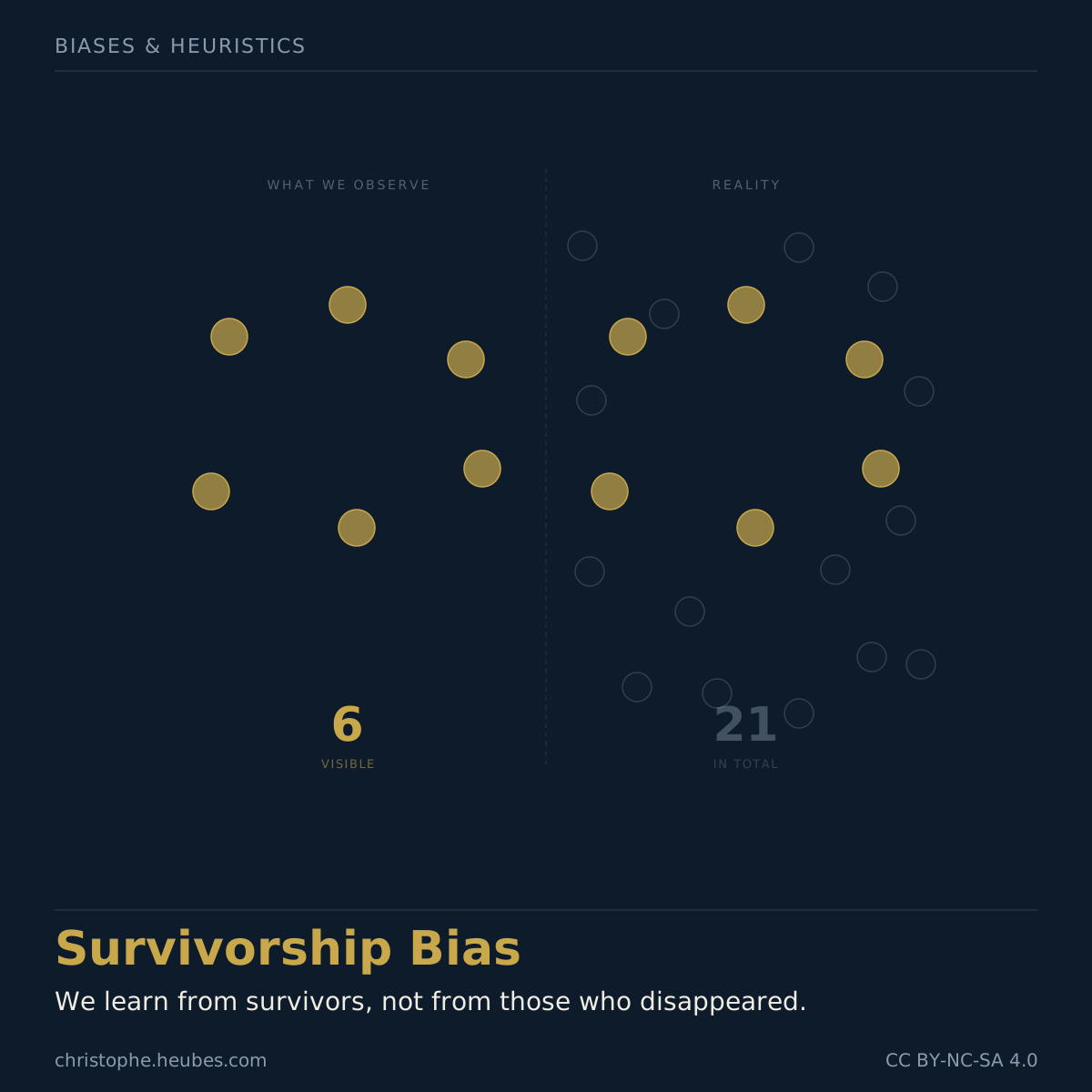
Survivorship bias is a cognitive error in which conclusions are drawn only from cases that survived a selection process, while forgetting that eliminated cases are invisible, and yet statistically the majority.
The expression comes from the analysis of Second World War aircraft: engineers wanted to reinforce the most-hit areas on planes that returned to base. Abraham Wald pointed out that those were precisely the areas that did not need extra armour, aircraft hit there survived. The truly critical spots were the ones with no damage… because planes hit there never came back.
Why it matters
This bias profoundly distorts our perception of reality:
In entrepreneurship: we read the biographies of Steve Jobs, Elon Musk, Jeff Bezos. We don’t read the memoirs of the thousands of entrepreneurs with similar profiles who failed. As a result, we overestimate the role of charisma, vision, and risk-taking: while ignoring luck and context.
In finance: investment funds that have disappeared no longer appear in performance databases. Performance comparisons are made only among survivors, which inflates averages.
In medicine: some treatments appear effective because patients who dropped out (or died) are no longer counted in the success statistics.
In history: we study empires that endured, winning military strategies, innovations that broke through. The graveyard of disappeared ideas, civilisations, and inventions remains largely invisible.
Concrete examples
Advice from self-made millionaires: when a successful entrepreneur attributes their success to a precise routine, mindset, or method, they ignore the thousands of people who followed the same path without result. The advice becomes selection bias dressed up as a lesson.
Studies on centenarians: analysing the habits of people aged 100 to identify longevity factors suffers from the same bias, you can’t interview those who have died.
Leadership best-sellers: “excellent companies do X, Y, Z”: but ordinary companies do too. You’re only comparing survivors.
Counter-measures: systematically ask “what data is missing?”, seek out failure cases with the same profile, investigate exits and drop-outs, and build complete reference baselines before drawing conclusions.
What we don’t see matters as much as what we do.