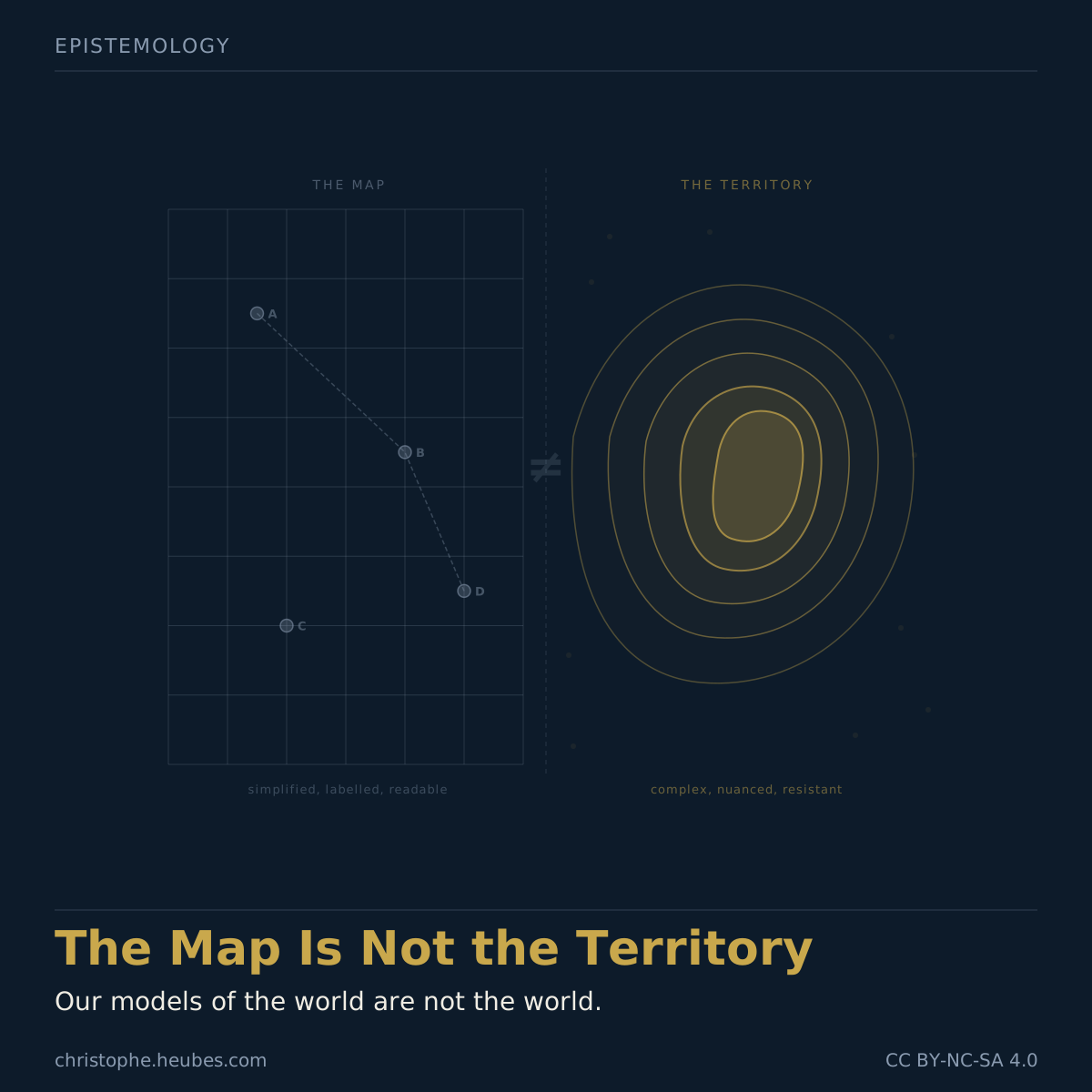
The Map Is Not the Territory
Our models of the world are not the world.
Definition
The aphorism “The map is not the territory” was formulated by Alfred Korzybski (1879–1950), founder of general semantics, in his work Science and Sanity (1933):
“A map is not the territory it represents, but, if correct, it has a similar structure to the territory, which accounts for its usefulness.”
In plain terms: any representation of a reality, map, model, theory, concept, word, is a simplification. It cannot capture the totality of what it represents. And confusing the representation with reality itself is a fundamental source of error.
This idea was taken up and popularised by Gregory Bateson, neuro-linguistic programming (NLP), the philosophy of language, and cognitive science.
Why it matters
Every time we use a model, a map, a concept, or a word, we are working with a simplification: and we must keep that in mind:
In management: a dashboard is a map. It measures certain indicators, not complete operational reality. Optimising metrics rather than the underlying reality is the map/territory confusion par excellence (see also: Goodhart’s Law).
In science: all scientific models are wrong; some are useful. Newtonian physics is “wrong” at the quantum scale, it remains an extraordinarily useful map for most applications.
In sociology and economics: economic models assume rational agents, perfect markets, and stable preferences. Reality (the territory) is infinitely more complex. Crises often occur when we forget that the model is not reality.
In language: the word “dog” is not a dog. A category (“the French”, “millennials”) is not the set of individuals it describes. Treating abstractions as concrete realities is a source of bias and faulty reasoning.
Concrete examples
The city map: a map of London does not show ongoing roadworks, closed streets, smells, sounds, or crowds. It is a useful abstraction, not London.
Financial models: the 2008 crisis was partly caused by risk models that assumed a normal distribution of extreme events. The quants had confused their map with real financial territory.
Medical diagnosis: diagnostic categories (DSM, ICD) are maps of human suffering. Useful for communicating and treating, they do not capture the complexity of each individual patient.
The org chart: the official structure of an organisation is not its actual functioning. Real flows of power, information, and decision-making rarely follow the boxes and hierarchical lines.
Counter-measures: regularly ask “what does this model not capture?”, diversify sources of representation, confront models with raw data, and remain humble in the face of the complexity of real territory.
All models are wrong. Some are useful.