Dunning-Kruger Effect
The less you know, the more confident you feel.
Definition
The Dunning-Kruger Effect is a cognitive bias identified by psychologists David Dunning and Justin Kruger in a 1999 study published in the Journal of Personality and Social Psychology. Their core finding:
Incompetent individuals in a domain lack precisely the metacognitive abilities required to recognise their own incompetence.
In other words: knowing what you don’t know already requires a level of competence that novices have not yet acquired. Ignorance is, by nature, invisible to those who experience it.
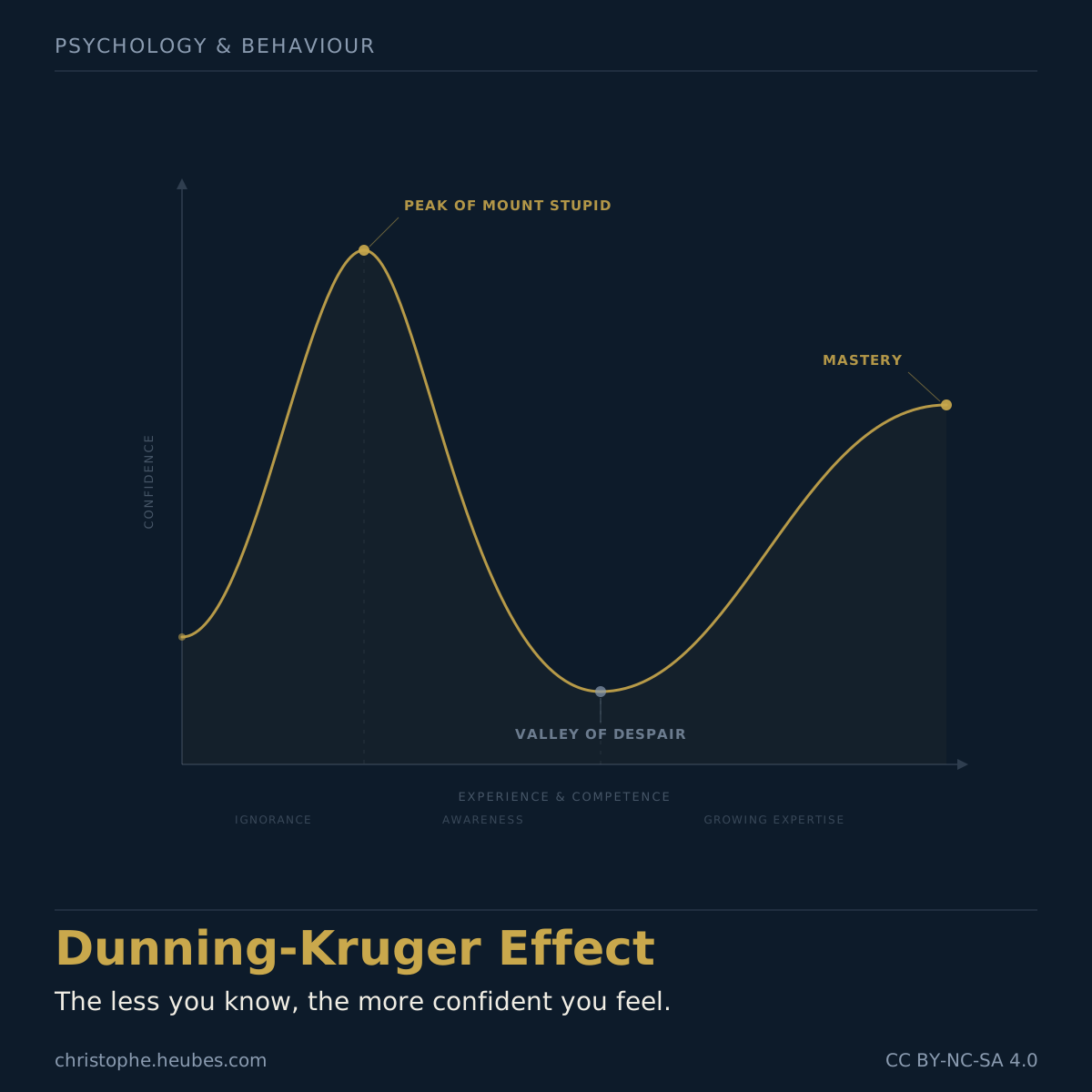
The characteristic curve follows four phases:
- Peak of Mount Stupid: the beginner discovers a domain and quickly gains confidence, without grasping the extent of what they don’t know.
- Valley of Despair: progressive exposure to complexity collapses confidence; one suddenly realises the immensity of what remains to be learned.
- Slope of Enlightenment: real competence grows; confidence rises again, this time grounded in genuine mastery.
- Plateau of Sustainability: the expert holds stable confidence, often more modest than the novice’s.
Why it matters
This bias appears across almost every professional and social context:
In management: an inexperienced leader may make rapid, decisive decisions where an expert hesitates, not because they see more clearly, but because they haven’t yet measured the risks. Their apparent confidence can be perceived as leadership while actually reflecting unconscious ignorance.
In public debate: people least informed on a topic (epidemiology, economics, law) are often the most assertive in their positions. The complexity is simply invisible to them.
In recruiting: candidates who overestimate their competence sometimes perform better in interviews than experts who self-assess more accurately.
In learning: the valley of despair is the phase where most people give up, just before real competence begins to build.
Concrete examples
Self-taught investors: a few months after starting to trade, many believe they can beat the market. The correction typically arrives with the first real downturn.
Driving: young drivers (< 2 years’ licence) are statistically both the most accident-prone and the most confident in their driving ability.
AI tools: initial enthusiasm for ChatGPT or other LLMs often leads to a phase of overestimation of their capabilities, before real use reveals their limits and hallucinations.
Counter-measures: actively seek corrective feedback, expose yourself early to domain experts, practise adversarial thinking on your own conclusions.
Confidence without competence is dangerous. Competence without confidence is wasted.