Brandolini's Law
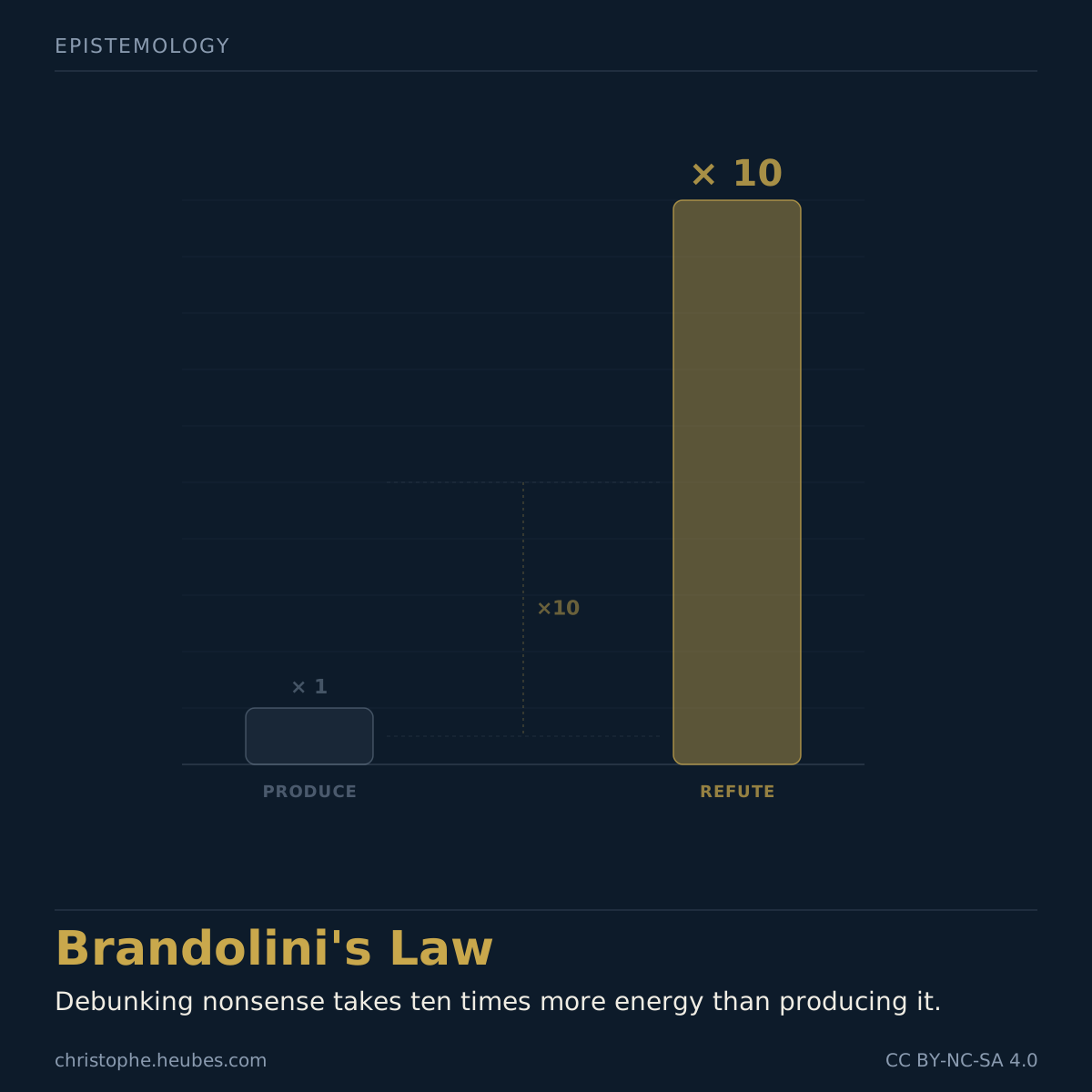
Debunking nonsense takes ten times more energy than producing it.
Definition
Brandolini’s Law (or the Bullshit Asymmetry Principle) was formulated by Italian developer Alberto Brandolini in 2013, on Twitter:
“The amount of energy needed to refute bullshit is an order of magnitude bigger than to produce it.”
Producing a false claim is trivial: one sentence suffices. Refuting it requires gathering evidence, understanding the context, deconstructing the argument, addressing each sub-hypothesis, and doing so in a way that is comprehensible to the target audience.
Why it matters
This asymmetry profoundly structures public debate and collective epistemology:
In media and social networks: false information spreads with a single click. Its detailed, sourced, and nuanced refutation attracts only a fraction of the attention. The production/refutation asymmetry is amplified by algorithms that favour emotion over precision.
In political debates: a fallacious argument raised during a televised debate puts the opponent in an impossible position, a complete refutation would take 10 minutes, but the format allows only 30 seconds. This phenomenon is sometimes called the “Gish Gallop” (flooding an opponent with false arguments to exhaust them).
In scientific disinformation: lobbies that deny climate change, the risks of tobacco, or the benefits of vaccines do not need to produce science: they produce doubt. Doubt is easy to create, slow to dissipate.
In business: a poorly sourced alarmist report can paralyse an organisation for weeks, even if its refutation takes a day’s work. The asymmetry benefits those who act in bad faith.
Concrete examples
WhatsApp chains: a 3-line message claiming a vaccine contains microchips requires 20 sources, 3 paragraphs of biological explanation, and 5 minutes of reading to refute: and even then, only if the reader is receptive.
Climate denial: the scientific position on climate change rests on decades of publications. Sowing doubt required only a few reports paid for by oil lobbies.
Viral fake news: studies show that false information spreads 6 times faster than true information on Twitter/X. The truthfulness of information is a brake on its propagation, not an accelerator.
Practical implications: faced with this asymmetry, some experts recommend not systematically refuting every false claim (which can sometimes amplify its visibility), but instead building strong alternative narratives.
Counter-measures: prioritise high-impact refutations rather than exhaustiveness, invest in media literacy upstream, and create refutation formats adapted to the same channels as disinformation.
Lying is the only sport where the defender works ten times harder than the attacker.