Carlson's Law
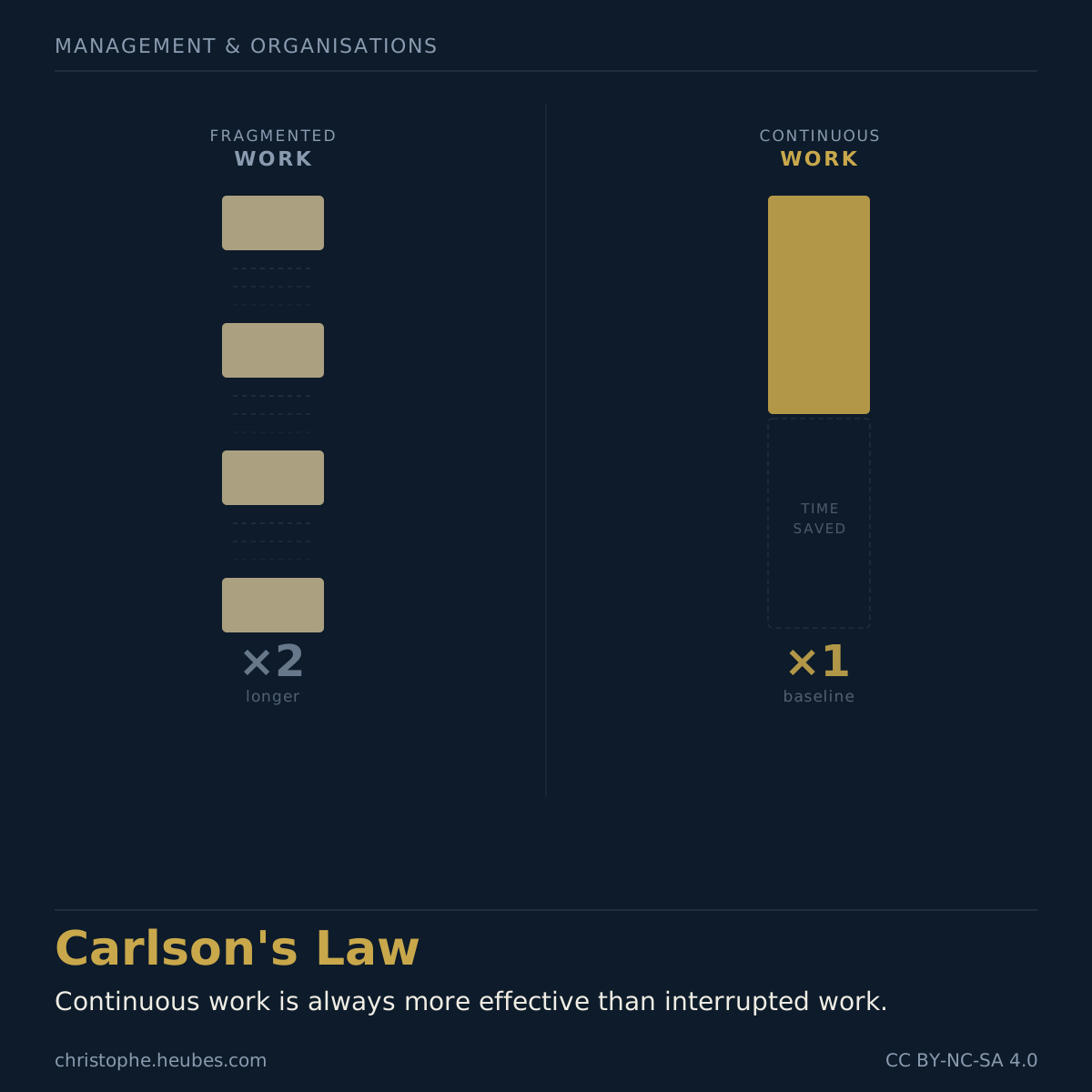
Continuous work is always more effective than interrupted work.
Definition
Carlson’s Law was formulated by Swedish economist Sune Carlson in his 1951 work Executive Behaviour. It states:
“Work carried out continuously is always performed in a shorter time and at a higher quality than work done in several instalments.”
The principle rests on a simple neurological mechanism: deep concentration takes time to establish, between 15 and 25 minutes depending on the individual. Every interruption erases this concentrated state, forcing a complete restart cycle.
In practice, a task requiring 2 hours of real work may demand 4 to 6 hours when performed in fragmented sessions, without any improvement in quality.
Why it matters
In a modern work environment, sources of interruption are everywhere: notifications, instant messages, unplanned meetings, open-plan offices. These interruptions don’t just cost their own duration: they also cost:
- The mental reconfiguration time after each break
- Quality degradation from losing context
- Cognitive fatigue accumulated through repeated mode-switching
Carlson’s Law is the theoretical foundation behind practices such as time blocking, deep work (Cal Newport), and work sprints from the Pomodoro technique.
Concrete examples
Writing: an article that takes 3 uninterrupted hours to write will often take 2 days if approached in 20 mini-sessions of 20 minutes. The result will be lower quality and the process, exhausting.
Coding: a developer interrupted every 20 minutes to answer messages cannot reach the flow state required for complex tasks. Debugging or architecture design requires 2-to-4-hour blocks.
Management: a leader who accepts all team interruptions dilutes their own capacity to handle complex topics. The solution is not inaccessibility, but clearly communicated protected time slots.
Protecting your continuous work blocks is the highest-return productivity decision you can make.