Conway's Law
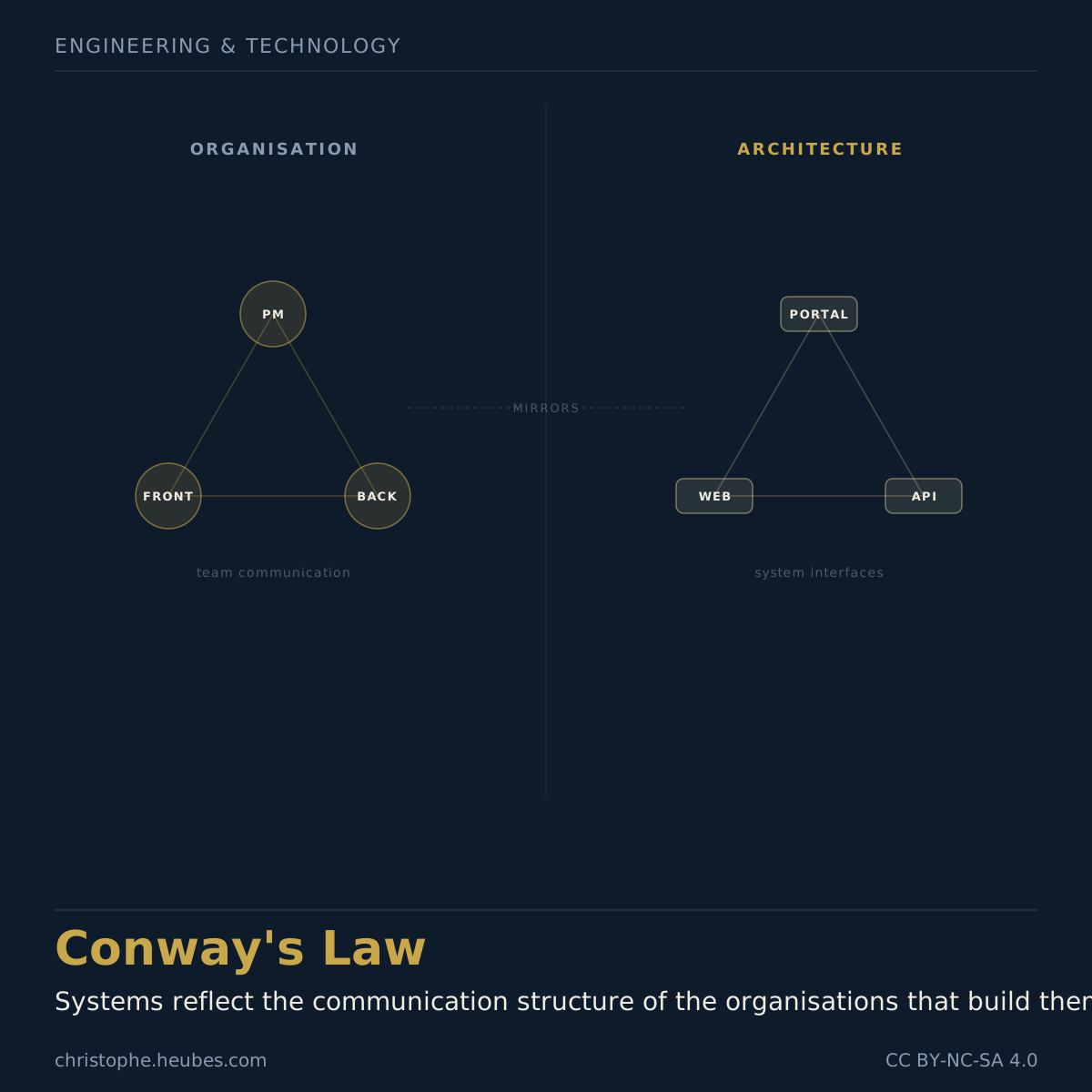
Systems reflect the communication structure of the organisations that build them.
Definition
Conway’s Law was formulated by American computer scientist Melvin Conway in an article submitted in 1967 to Harvard Business Review (rejected, then published in Datamation):
“Any organization that designs a system will produce a design whose structure is a copy of the organization’s communication structure.”
In other words: the boundaries in your technical architecture reproduce the communication boundaries of your organisation. If three teams build a compiler, it will have three passes. If frontend and backend only exchange through a rigid API, it’s because the teams only talk through tickets.
Why it matters
Conway’s Law is not a criticism, it is a law of the social nature of systems. It has concrete implications:
The problem: if the organisation is poorly structured (silos, poor communication, duplicated responsibilities), the system it produces will be too: regardless of the individual quality of its engineers.
The inverse (Reverse Conway Maneuver): rather than letting the organisation dictate the architecture, design the target organisation around the desired architecture. If you want independent microservices, create independent teams with end-to-end ownership. This is the principle behind product teams and the Team Topologies methodology.
Concrete examples
Amazon: the two-pizza teams architecture (5-8 person teams, autonomous and responsible for an end-to-end service) produced AWS, a collection of independent services with clean APIs. This is not an architectural accident; it directly reflects the organisational structure.
Monolith → microservices: companies that try to decompose a monolith without restructuring their teams produce “distributed monoliths”, the worst of both worlds. The architecture won’t change if the teams don’t change.
Bureaucracy: an organisation with many hierarchical layers and slow validation processes will produce systems that are slow to deploy, with many dependencies and long release cycles.
Want to change your architecture? Start by changing your teams.