Hick's Law
The more choices, the longer the decision takes.
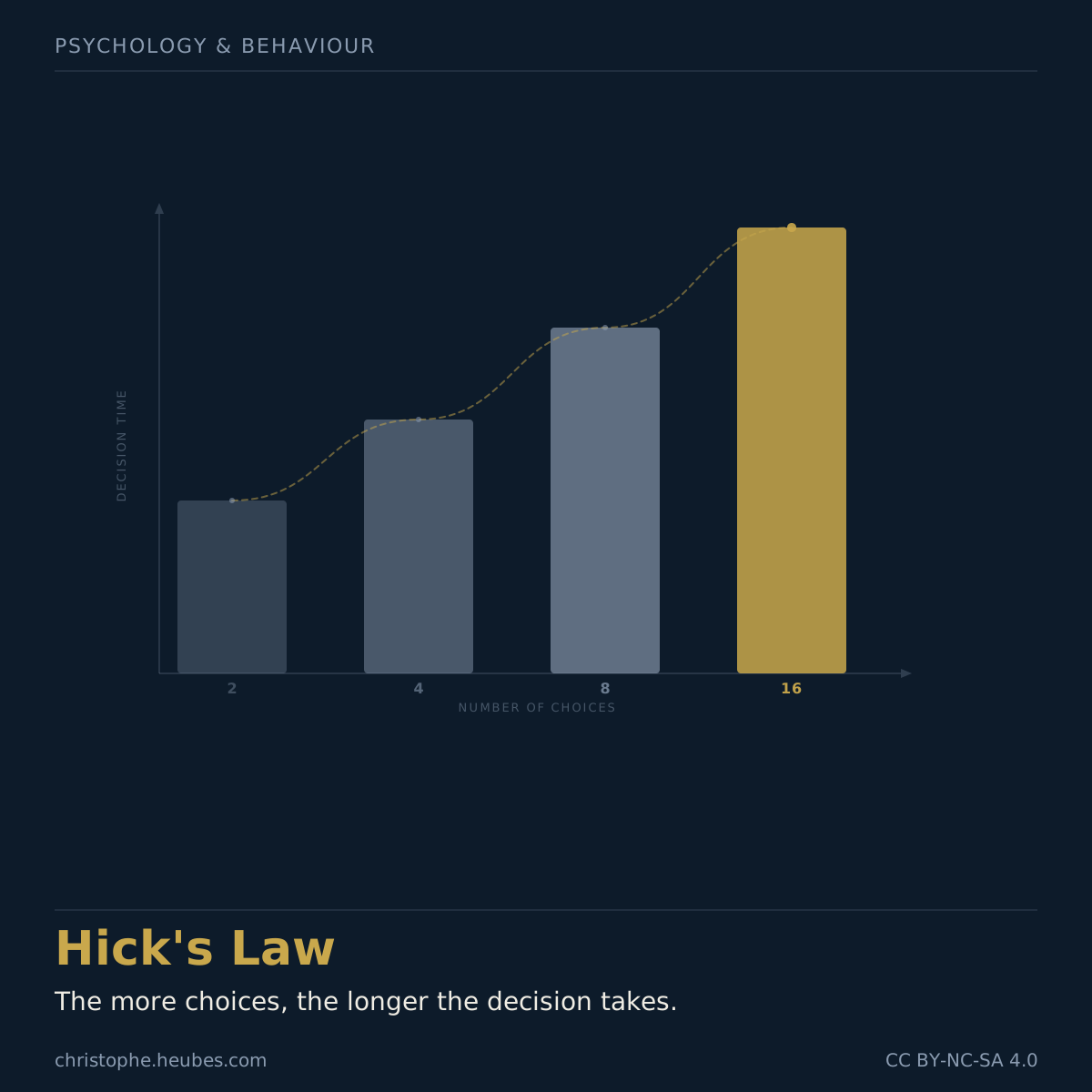
Definition
Hick’s Law (or the Hick-Hyman Law) was formalised in 1952 by British psychologist William Edmund Hick, then independently confirmed by Ray Hyman. It expresses the relationship between the number of available options and the time needed to make a decision:
T = b × log₂(n + 1)
where T is reaction time, n is the number of stimuli or alternatives, and b is an empirical constant.
The relationship is logarithmic: doubling the number of choices does not double decision time, but adds a fixed amount. In practice, cognitive saturation sets in very quickly.
Why it matters
Hick’s Law is fundamental to interface design, UX, and strategy:
In design: each additional option in a menu slows the user down. A 16-item menu takes far more than double the time of a 2-item menu. The best interfaces limit the number of simultaneous choices.
In sales: too many options paralyse the buyer. Studies on the “paradox of choice” (Barry Schwartz) show that excessive offerings reduce conversions, customers leave without buying.
In emergencies: in critical situations (cockpit, resuscitation room, power plant control room), too much simultaneous information dangerously increases reaction time.
In strategy: a company with 12 priorities has none. Reducing options frees up cognitive bandwidth.
Concrete examples
Netflix: the paradox of choice is well-documented on streaming platforms, the more content available, the harder users find it to choose, spending more time scrolling than watching.
Restaurant menus: starred restaurants generally offer fewer options than family chains. This is no accident, perceived quality increases with selectivity.
Forms: each additional field in a form reduces completion rates. Hick’s Law justifies “progressive disclosure” approaches that hide advanced options.
Self-service checkouts: the number of steps on a touchscreen is directly correlated with user errors and frustration.
Counter-measures: group options into categories (chunking), hide secondary options, order choices by frequency of use, and always offer a clear default option.
Simplifying means deciding on behalf of others. Not simplifying forces that work onto them.