Hofstadter's Law
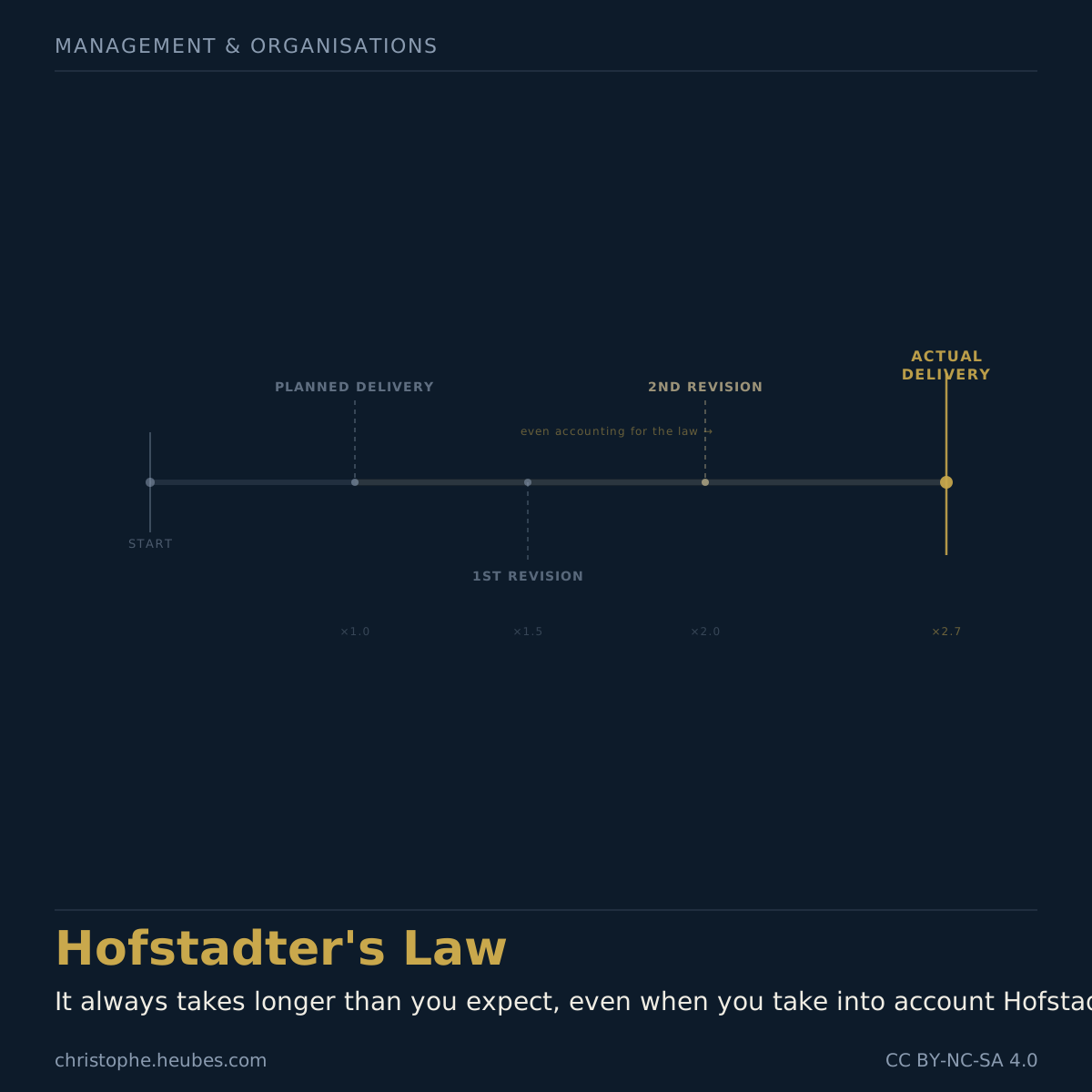
It always takes longer than you expect, even when you take into account Hofstadter's Law.
Definition
Hofstadter’s Law was formulated by Douglas Hofstadter in his 1979 book Gödel, Escher, Bach: An Eternal Golden Braid. Its defining characteristic: it is self-referential: it applies to itself.
“It always takes longer than you expect, even when you take into account Hofstadter’s Law.”
This is not simply an observation that “projects run late.” It is a stronger claim: even knowing that you will underestimate, you still underestimate. The correction of the bias is itself biased.
Why it matters
This phenomenon stems from several combined mechanisms:
Optimism bias: we naturally overestimate our future capabilities and underestimate upcoming obstacles.
Planning under ideal conditions: estimates implicitly assume everything will proceed without interruption, dependencies, ambiguity, or surprises.
The decomposition effect: breaking a project into subtasks does not solve the problem: each subtask contains Hofstadter’s Law within it.
Recursivity: attempting to correct estimates by adding a “buffer” is insufficient, because the buffer itself will be consumed by unforeseen events that were themselves underestimated.
Concrete examples
Software development: Hofstadter’s Law is almost an industry adage. Software projects are chronically late and over budget, even when teams plan with past overruns in mind.
Large infrastructure: the Channel Tunnel, the Sydney Opera House, or the Olympics: almost no major project is delivered on time and within its initial budget.
Writing a book: authors who estimate “6 months” rarely finish in under 18. And those who revise to 18 months often exceed 30.
Renovation: no renovation project finishes within the announced timeline or budget, even by experienced professionals.
Counter-measures: systematically apply an empirical multiplier (×2 or ×3), plan in short phases with intermediate deliveries, and treat estimates as orders of magnitude rather than commitments.
Estimating precisely is impossible. Estimating with humility is essential.