Pareto's Law
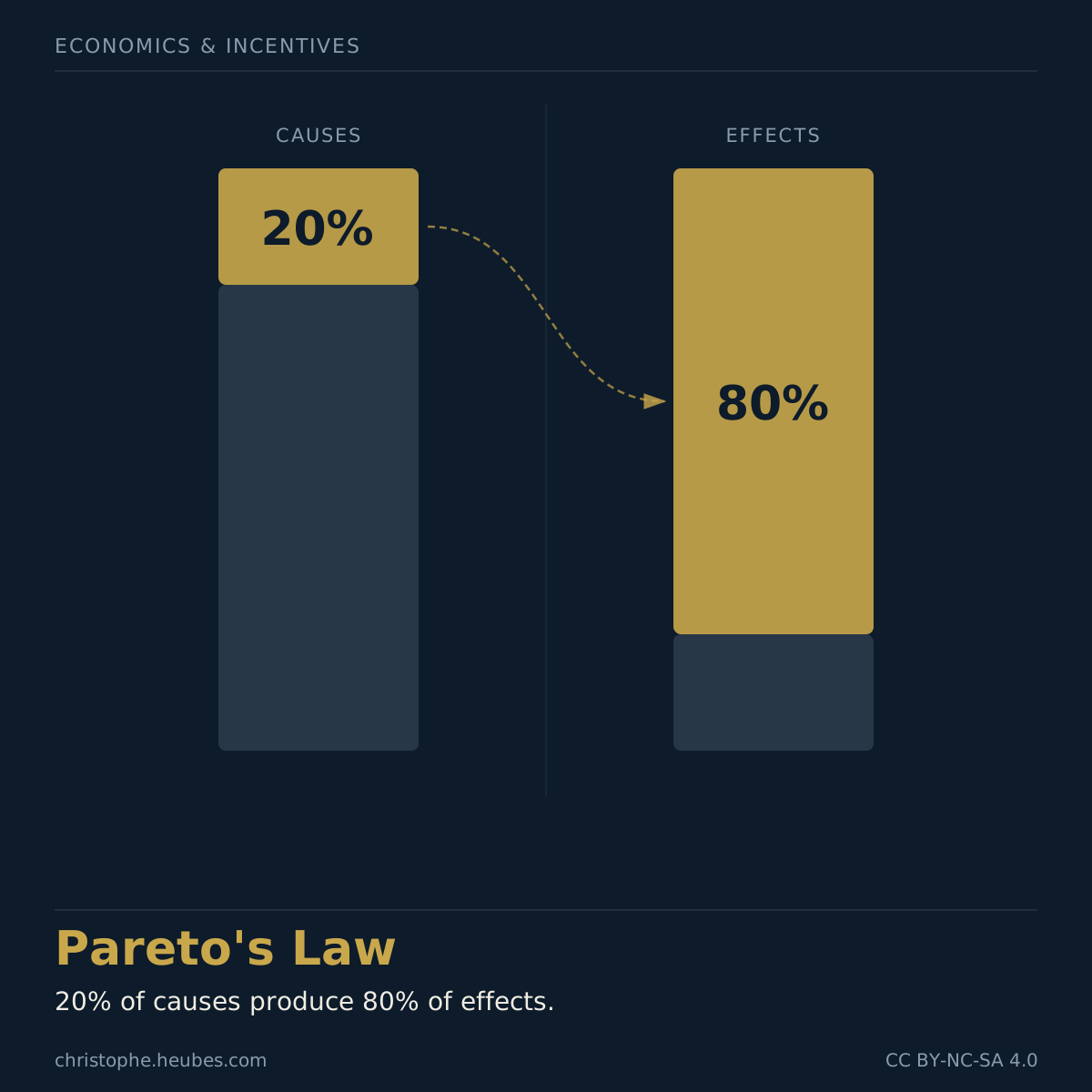
20% of causes produce 80% of effects.
Definition
Pareto’s Law, also known as the 80/20 rule, states that, in many systems, roughly 20% of causes are responsible for 80% of effects. It is named after Italian economist Vilfredo Pareto, who observed in 1896 that 20% of landowners held 80% of Italy’s land.
The principle was later generalised by management consultant Joseph Juran in the 1940s, who applied it to industrial quality improvement.
It is not an absolute physical law, the proportions vary (70/30, 95/5), but the asymmetric structure is remarkably consistent: a minority of causes concentrates a majority of results.
Why it matters
Resources are finite: time, energy, money, attention. Pareto’s Law is a radical prioritisation tool:
- In a task list, 20% of tasks generate 80% of the value produced
- In a client portfolio, 20% of clients typically represent 80% of revenue
- In a codebase, 20% of bugs cause 80% of crashes
- In a warehouse, 20% of SKUs drive 80% of sales
Ignoring the asymmetric distribution means treating all causes with equal urgency, and diluting your impact.
Concrete examples
Project management: identify the 2–3 critical tasks that will unlock 80% of deliverables, rather than exhausting yourself on a comprehensive list.
Marketing: concentrate budgets on the channels that actually generate conversions, not those that merely appear active.
Customer support: solve the 20% of recurring problems that generate 80% of tickets, rather than handling each ticket in isolation.
Learning: in a foreign language, mastering the 1,000 most frequent words covers ~80% of conversations: before tackling rare vocabulary.
Finding your 20% is not about efficiency: it’s about clarity on what actually matters.