Maslow's Hammer
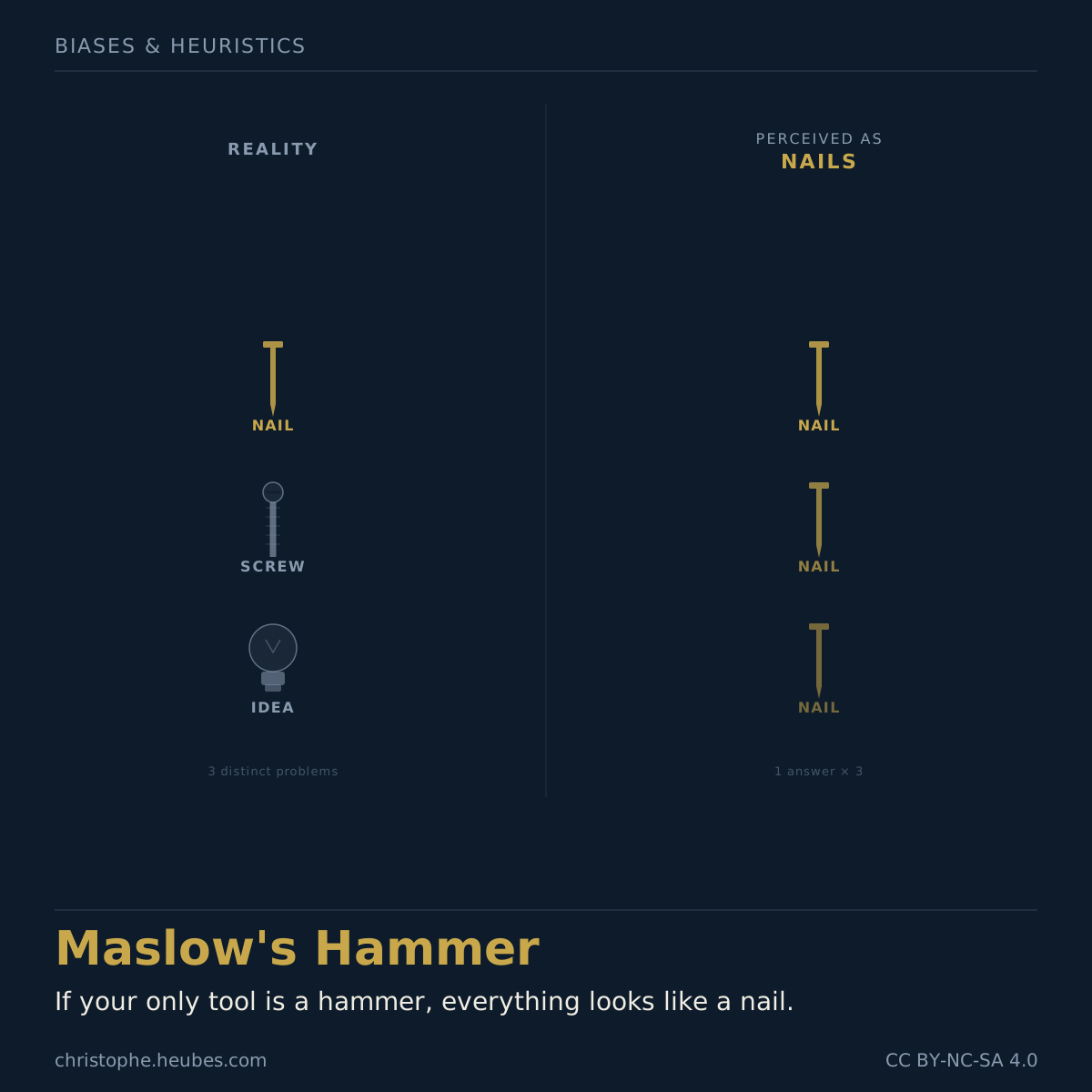
If your only tool is a hammer, everything looks like a nail.
Definition
Maslow’s Hammer, also known as the Law of the Instrument or Golden Hammer, takes its name from a formulation attributed to psychologist Abraham Maslow in his 1966 work The Psychology of Science:
“I suppose it is tempting, if the only tool you have is a hammer, to treat everything as if it were a nail.”
This is not a criticism of competence, but a description of an unavoidable cognitive bias: familiarity with a tool unconsciously distorts how we perceive problems. The more proficient we are with a tool, the more we tend to see opportunities to use it: even where it is not appropriate.
Why it matters
Maslow’s Hammer appears at every level:
The technical expert applies their favourite technology to every project: the Python developer writes a script where a spreadsheet would do, the cloud architect proposes a distributed solution for a load a single server could handle.
The leadership team always reaches for the same lever, cost reduction, reorganisation, internal communication, whichever they know best, not necessarily the most appropriate.
The consultant applies the same framework to every client, because that is what they have sold and refined for years.
The danger is not in the tool itself, a hammer is excellent for a nail, but in the absence of perspective on the fit between tool and problem.
Concrete examples
Tech: a company trained exclusively on a proprietary technology (SAP, Salesforce, Excel…) tends to reconfigure all its processes to fit that tool, rather than choosing the tool that fits the process.
Management: a leader whose only lever is authority will treat cultural problems as obedience problems, and make things worse.
AI: amid enthusiasm for LLMs, some teams try to solve with a language model what is really a simple SQL query or a business rule.
Counter-measures: regularly mapping your “tool arsenal,” seeking outside perspectives, and starting by formulating the problem before thinking about the solution.
Mastery of a tool is a strength. Believing it universal is a bias.