Hanlon's Razor
Never attribute to malice what can be explained by incompetence.
Definition
Hanlon’s Razor is an aphorism attributed to Robert J. Hanlon, popularised in the 1980s:
“Never attribute to malice what can be adequately explained by stupidity.”
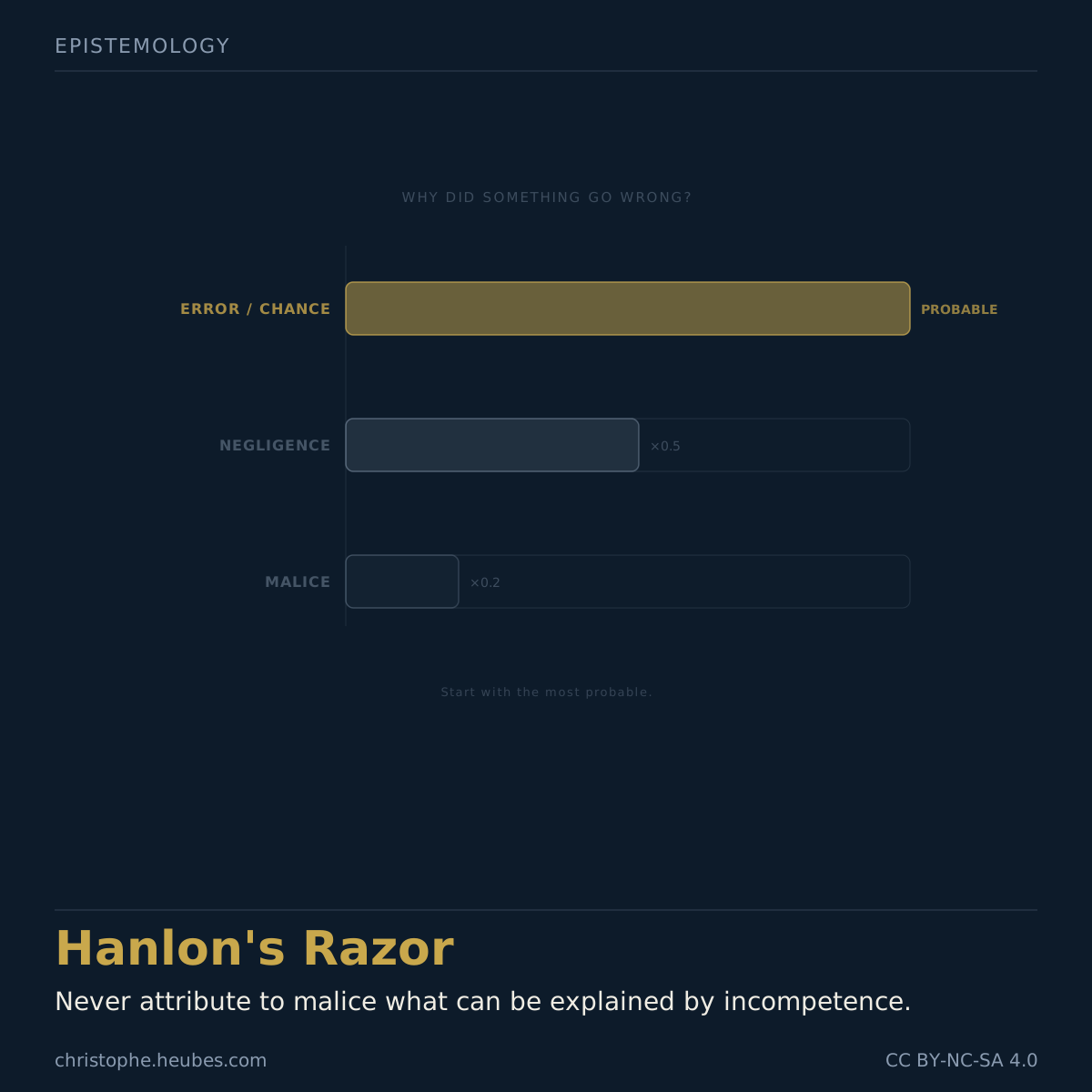
Contemporary formulations often prefer “incompetence” or “negligence” to “stupidity”. The core idea remains: before assuming hostile intent, first look for a more ordinary explanation: error, clumsiness, ignorance, cognitive overload.
This principle is a form of razor (in the sense of a simplification tool) applied to human intentions: we “shave off” the malice hypothesis unless there is evidence to the contrary.
Why it matters
Attributing malice is costly, it damages relationships, polarises groups, and prevents solving the real problem:
In organisations: when a colleague doesn’t reply to an urgent email, the first interpretation is often “they’re ignoring me” or “they’re sabotaging things”. The likely reality: full inbox, unexpected meeting, competing priority. Attributing malice generates unnecessary conflict.
In political life: political opponents are often presented as malicious. Hanlon’s Razor invites us to consider first that they hold different convictions, have different information, or have cognitive blind spots: not necessarily bad intentions.
In cybersecurity: the majority of security incidents stem from human error (misconfiguration, phishing through inattention), not sophisticated planned attacks. Treating every incident as a targeted attack misdirects the response.
In project management: a missed deliverable is more often due to a misunderstood requirement, an unrealistic schedule, or underestimated technical constraints than to bad faith.
Concrete examples
The manager who doesn’t delegate: from below, this attitude can seem like control or distrust. From above, it’s more often anxiety, a lack of confidence in the team, or an unchallenged habit. Malice is rarely the cause.
The buggy product: frustrated users sometimes imagine that developers “don’t care”. The reality is more often accumulated technical debt, an undersized team, priorities imposed from above.
Kafkaesque bureaucracy: absurd rules are almost never designed to cause harm. They are the result of reasonable decisions made in forgotten contexts, legal protections, or uncoordinated accumulation.
The limits of the principle: Hanlon’s Razor does not exclude real malice. Some behaviours are genuinely intentional and harmful. The principle says: start with the most probable hypothesis, not stay there blindly.
Counter-measures: before reacting to behaviour perceived as hostile, ask “what non-malicious explanation is possible?”, look for contradictory signals (repeated pattern vs isolated incident), and verify the facts before concluding intent.
Malice is rare. Incompetence is universal.