The Shirky Principle
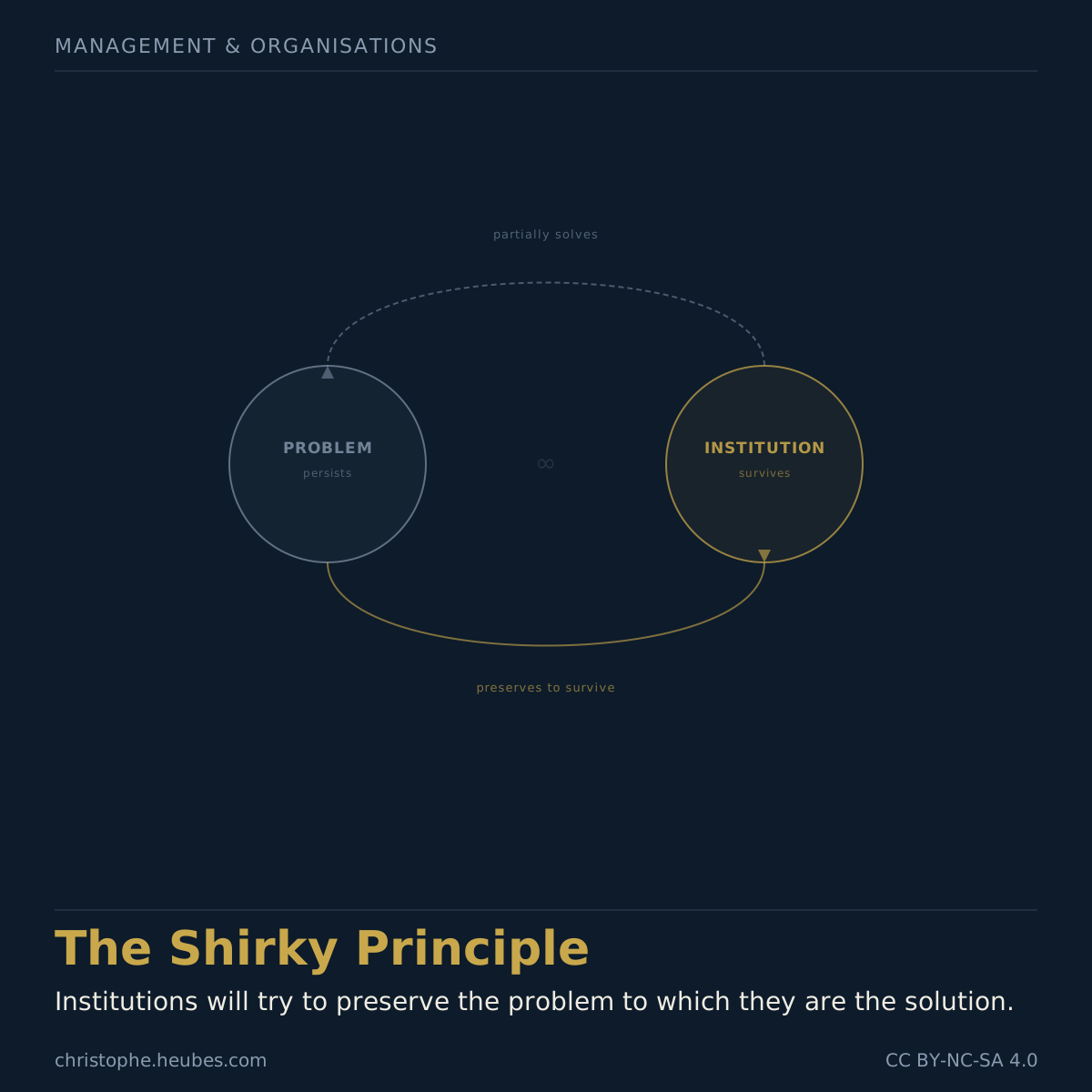
Institutions will try to preserve the problem to which they are the solution.
Definition
The Shirky Principle is an observation formulated by Clay Shirky, an essayist and professor specialising in the social impact of technology:
“Institutions will try to preserve the problem to which they are the solution.”
This is not necessarily a critique of the bad intentions of the individuals who make up these institutions. It is a structural observation: an organisation whose reason for being is a problem has an interest, consciously or not, in that problem persisting. Solving it definitively amounts to eliminating its own legitimacy.
Why it matters
This principle helps explain why certain social, economic, or technical problems persist despite decades of investment:
In the non-profit and NGO sector: an organisation created to fight poverty develops expertise, a bureaucracy, partnerships. Eradicating poverty would make it obsolete. The unconscious incentive pushes toward improving the situation: not resolving it completely.
In government: agencies created to address a specific problem tend to expand their mandate rather than dissolve once the objective is achieved.
In consulting: a consulting firm that fully solves its client’s problem loses that client. The incentive structure pushes toward “dependency” rather than “emancipation.”
In the pharmaceutical industry: chronically treating a symptom is structurally more profitable than curing it. The business model can diverge from the public health objective.
Concrete examples
Unions in declining industries: created to defend workers’ rights against a powerful industry, they can in some cases resist retraining toward new industries, which preserves their membership base but slows adaptation.
Proprietary antivirus software: their perceived value depends on the presence of threats. A world without malware would make their product useless. The incentives to fully solve the problem are therefore limited.
Compliance committees: the more complex the regulation, the more indispensable compliance teams become. Regulatory simplification threatens their very existence.
Public debt: institutions whose role is to manage debt have no structural interest in promoting its complete repayment.
Counter-measures: define clear “mission accomplished” criteria before creating an institution, build automatic dissolution mechanisms (sunset clauses), and separate the evaluators of the problem from the beneficiaries of its persistence.
An institution that solved its own problem would sign its own death warrant.