Occam's Razor
Between two equivalent explanations, choose the simpler one.
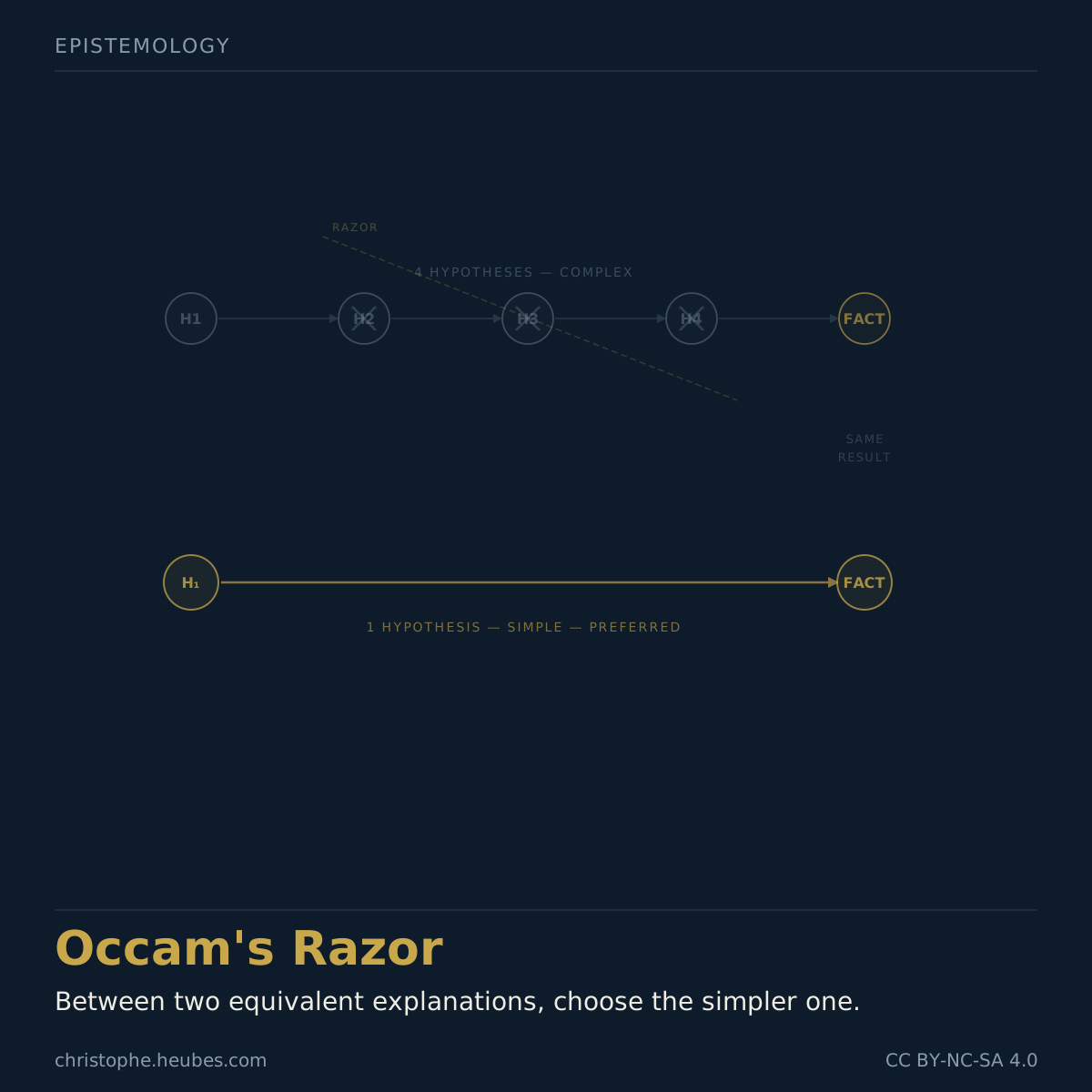
Definition
Occam’s Razor is a principle of parsimony formulated in the 14th century by the Franciscan philosopher William of Ockham. Its most well-known Latin formulation:
“Entia non sunt multiplicanda praeter necessitatem.” Entities should not be multiplied beyond necessity.
In plain terms: given two explanations producing the same result, prefer the one requiring fewer assumptions. This is not a law of nature, but a reasoning heuristic: a tool for cutting away the superfluous.
The term “razor” is a metaphor: we “shave off” unnecessary hypotheses to keep only the essential.
Why it matters
Occam’s Razor is a safeguard against over-explanation:
In science: when two theories explain observed data equally well, the simpler one is provisionally preferred. This is how Newton prevailed over Ptolemy, and Darwin over complex creationist theories.
In diagnostic medicine: the rule “diagnose common diseases first” is a form of Occam’s Razor. A coughing patient probably has a cold, not an exotic cancer, even though both explain the cough.
In engineering: faced with a bug, the simplest explanation (a wrong variable, an index out of bounds) should be tested before suspecting deep memory corruption or a compiler bug.
In management: if a team is underperforming, start by checking simple causes (unclear objectives, lack of resources) before invoking complex cultural problems.
Concrete examples
The motion of planets: Copernicus’s heliocentric model was simpler than Ptolemy’s epicycles, and proved more accurate. Occam’s Razor had pointed in the right direction.
Conspiracy theories: they systematically violate Occam’s Razor, they require dozens of additional assumptions (secret coordination, witness silence, evidence falsification) where a simple explanation suffices.
Debugging: faced with unexpected behaviour, the experienced engineer tests trivial hypotheses first before considering deep dysfunction. 80% of bugs have simple causes.
The limits of the razor: simplicity is not synonymous with truth. Some phenomena (quantum mechanics, evolution) are inherently complex. The razor is a starting point, not a verdict.
Counter-measures: list all the assumptions of an explanation before accepting it, compare the number of assumptions between competing explanations, and only add complexity when reality demands it.
Unnecessary complexity explains nothing better: it only conceals more.