Metcalfe's Law
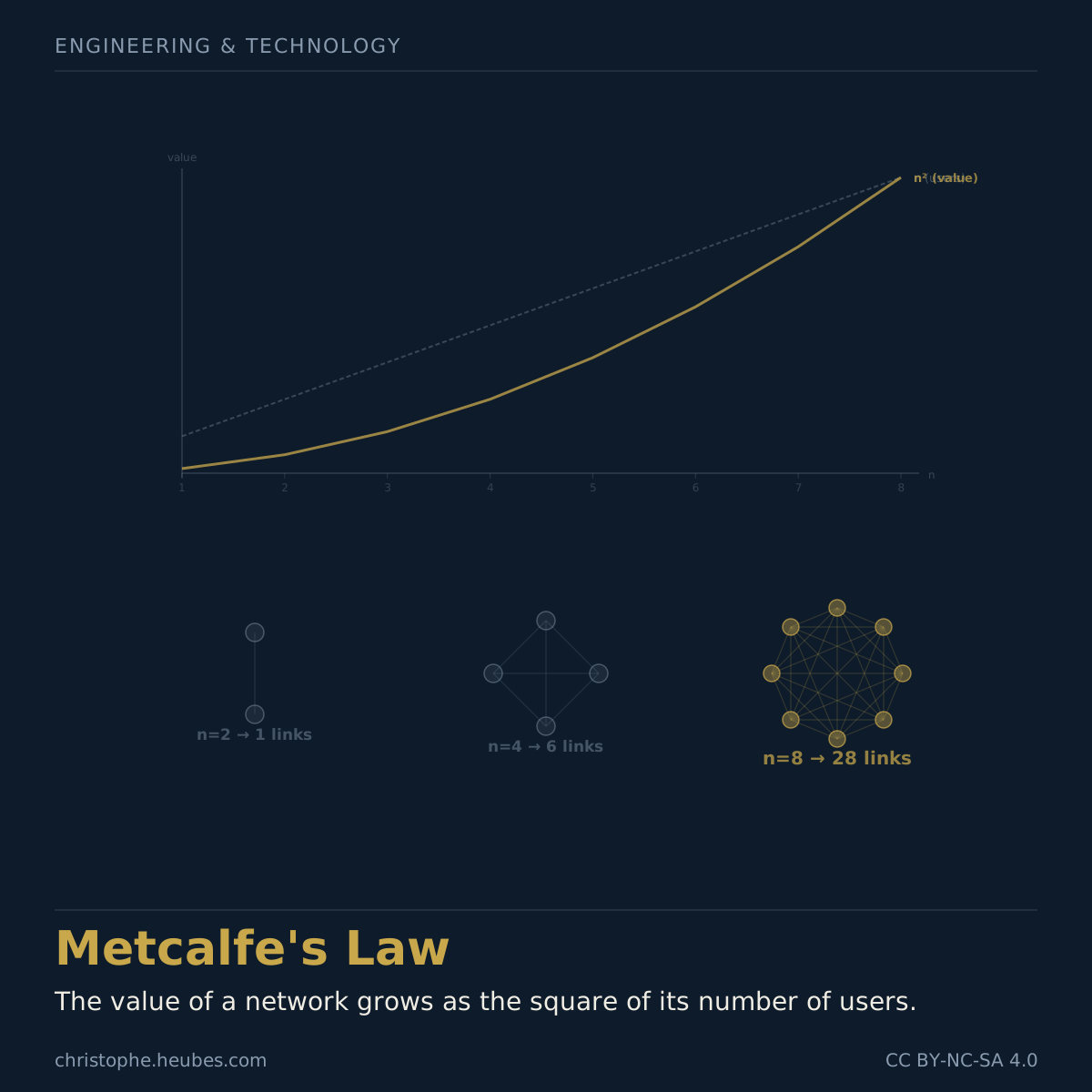
The value of a network grows as the square of its number of users.
Definition
Metcalfe’s Law captures the essence of network effects: every new user who joins a network does not merely add their own value, they create new potential connections with all existing members. If n users are connected, the number of possible links is n(n−1)/2, which grows quadratically.
A network of 2 people has 1 possible link. A network of 10 has 45. A network of 100 has 4,950. Value grows far faster than the number of users.
Why it matters
This law explains the winner-takes-all dynamics in platform markets: once a network reaches critical mass, it becomes exponentially more attractive than smaller competitors. It is the economic foundation of natural digital monopolies.
It also justifies hypergrowth strategies: lose money to acquire users rapidly, because the value of the network grows far faster than its marginal acquisition cost.
Concrete examples
Telephone: useless alone, valuable for two, indispensable when everyone has one.
Fax: exploded not when it became better, but when enough companies had one.
WhatsApp, Facebook, LinkedIn: their primary value is the network itself, not the features.
Open protocols (SMTP, HTTP): their universality is their value. A standard adopted by all is worth infinitely more than a superior standard adopted by few.