The Lindy Effect
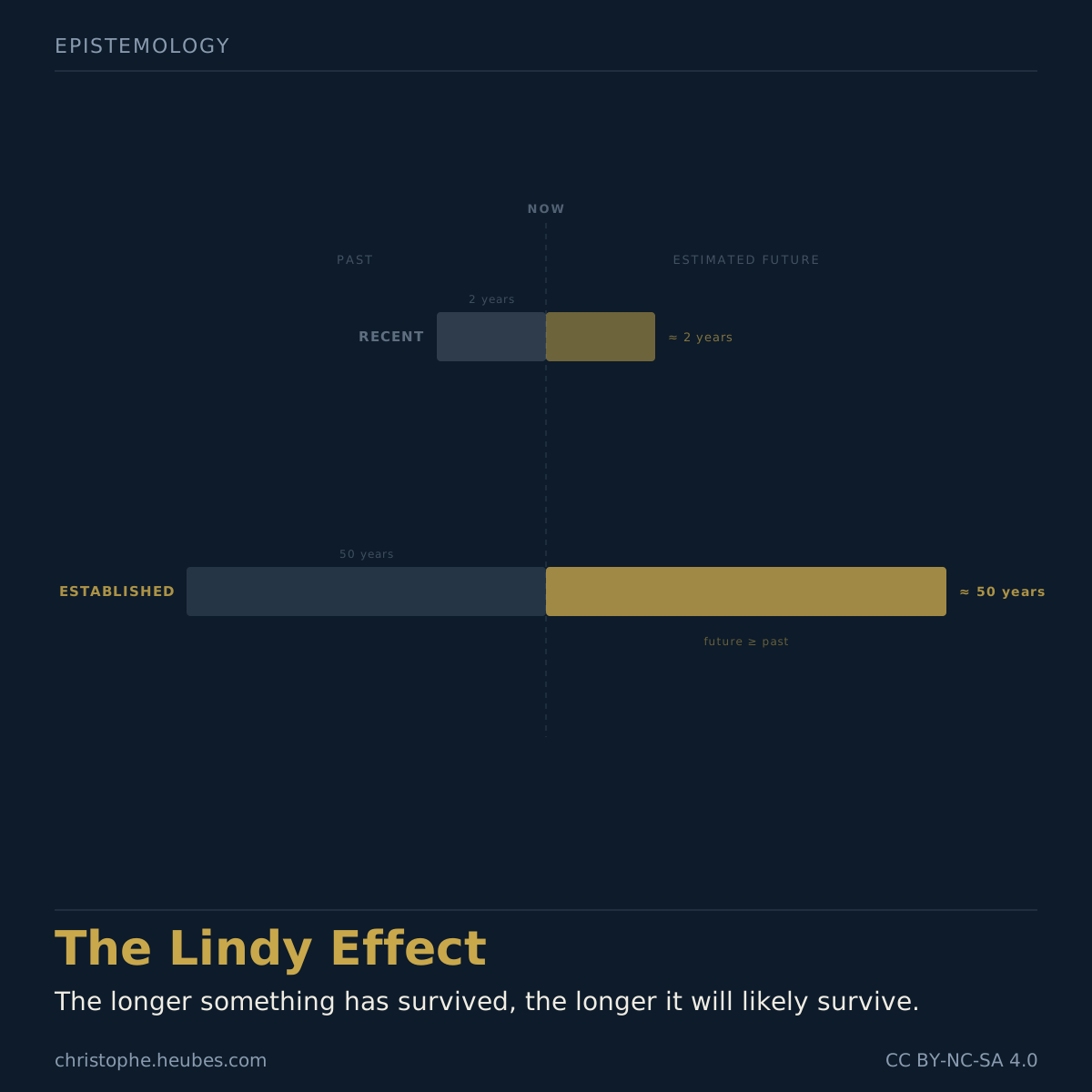
The longer something has survived, the longer it will likely survive.
Definition
The Lindy Effect is a heuristic originating from an observation made in the New York entertainment industry: TV shows that had already run for a long time were likely to run for much longer. Nassim Taleb formalised and popularised it in Antifragile (2012) and The Black Swan.
The principle: for non-perishable entities (ideas, texts, institutions, technologies), future lifespan grows with age. The longer an idea has survived, the longer it is likely to survive.
This is the opposite of the logic that governs biological or perishable entities, where the probability of death increases over time.
Why it matters
The Lindy Effect helps distinguish what endures from what disappears:
In culture: a book published 50 years ago and still being read is more likely to be read in 50 years than a recent bestseller released 6 months ago. Longevity filters for relevance.
In technology: protocols and programming languages that have existed for 30 years (C, SQL, Unix) will probably still be around in 30 years. The “revolutionary” frameworks of 2020 may be gone by 2025.
In business: an institution that has survived multiple crises, wars, and technological disruptions is probably more robust than a 2-year-old startup, whatever its promises.
In ideas: great philosophies, mathematics, or physical laws formulated centuries ago have proven their resilience through time itself.
Concrete examples
Books: Aristotle, Montaigne, Shakespeare continue to be read, studied, and translated. A viral essay from 2023 will probably be forgotten by 2030.
Technologies: email (1970s) and the web (1990s) are far more “immortal” than most SaaS applications born since 2010.
Institutions: religions, universities, and legal systems founded centuries ago have a longer expected future lifespan than most modern nation-states.
Counter-measures against anti-Lindy thinking: wariness of novelty for novelty’s sake, preference for what has proven itself over time, scepticism toward “revolutions” that have not yet survived their first winter.
What has endured is evidence of resilience. What is recent is still being tested.