Goodhart's Law
When a measure becomes a target, it ceases to be a good measure.
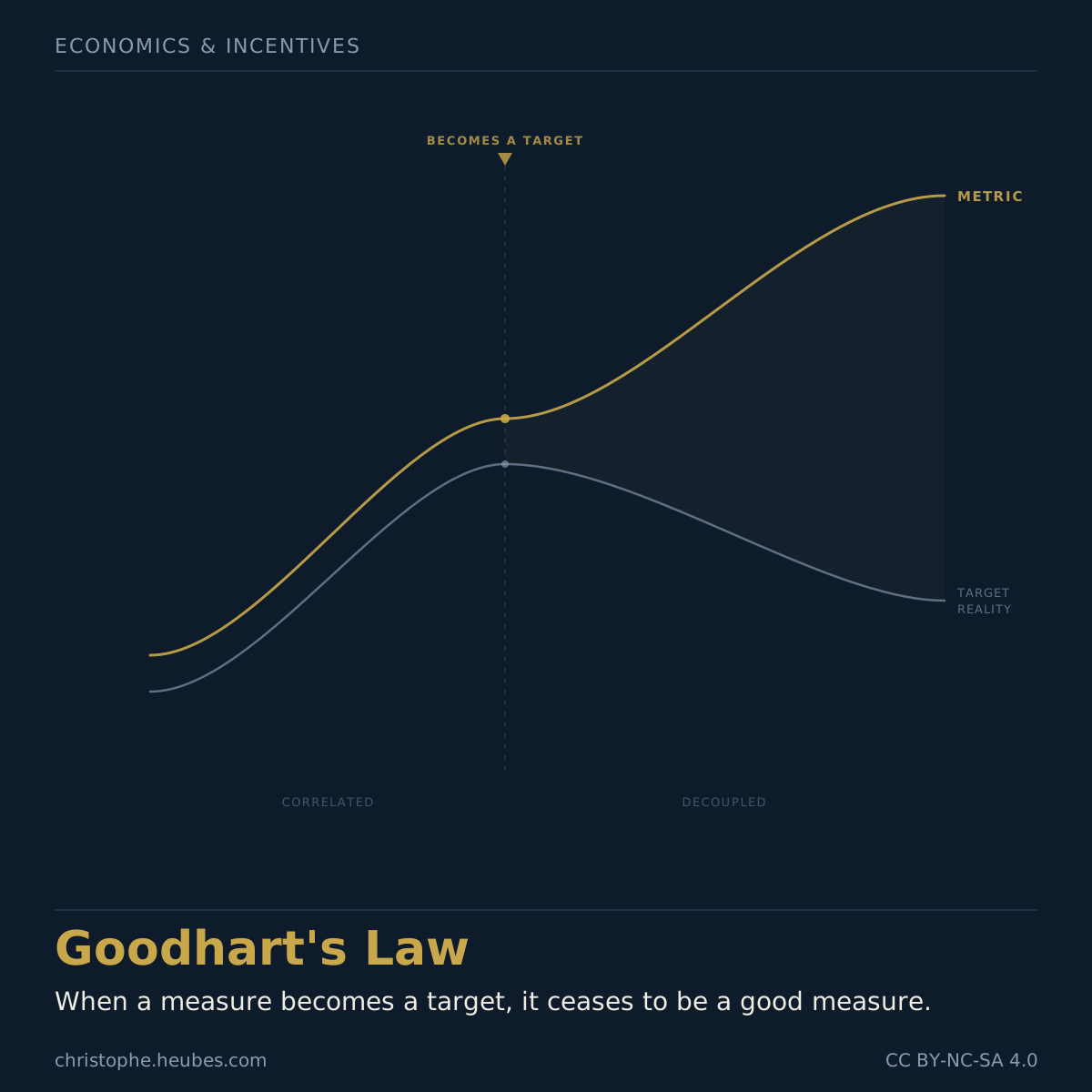
Definition
Goodhart’s Law is a principle formulated by British economist Charles Goodhart in 1975, initially in the context of British monetary policy:
“Any observed statistical regularity will tend to collapse once pressure is placed upon it for control purposes.”
Its popularised version, due to anthropologist Marilyn Strathern, is more pointed:
“When a measure becomes a target, it ceases to be a good measure.”
The core idea: an indicator is only useful as long as it remains an indirect reflection of reality. Once it becomes the target itself, actors optimise for the indicator, not for what it was meant to measure.
Why it matters
Goodhart’s Law explains the failure of many evaluation and management systems:
In management: setting a sales target based on the number of calls made incentivises sales reps to place short, valueless calls, the number goes up, sales stagnate.
In education: evaluating schools on exam pass rates pushes them to teach to the test rather than develop critical thinkers.
In technology: a mobile app optimised for average session time may achieve this by making the interface addictive rather than useful.
In healthcare: measuring hospital performance by mortality rate can incentivise them to turn away the most severe cases.
Concrete examples
Star ratings on platforms: once an average rating becomes a ranking criterion, sellers focus on inflating reviews rather than improving their product.
GDP: a powerful economic indicator, it poorly measures wellbeing, the environment, or inequality: yet remains the central goal of many policies.
Team KPIs: a developer measured by lines of code written will produce verbose code. A support agent measured by average resolution time will close tickets prematurely.
Counter-measures: use multiple indicators so as not to rely on a single one, separate those used for steering from those used for communication, and regularly reassess the relevance of each metric.
Measuring is essential. Confusing the measure with reality is a navigational error.