Dunbar's Number
We can only maintain ~150 stable relationships.
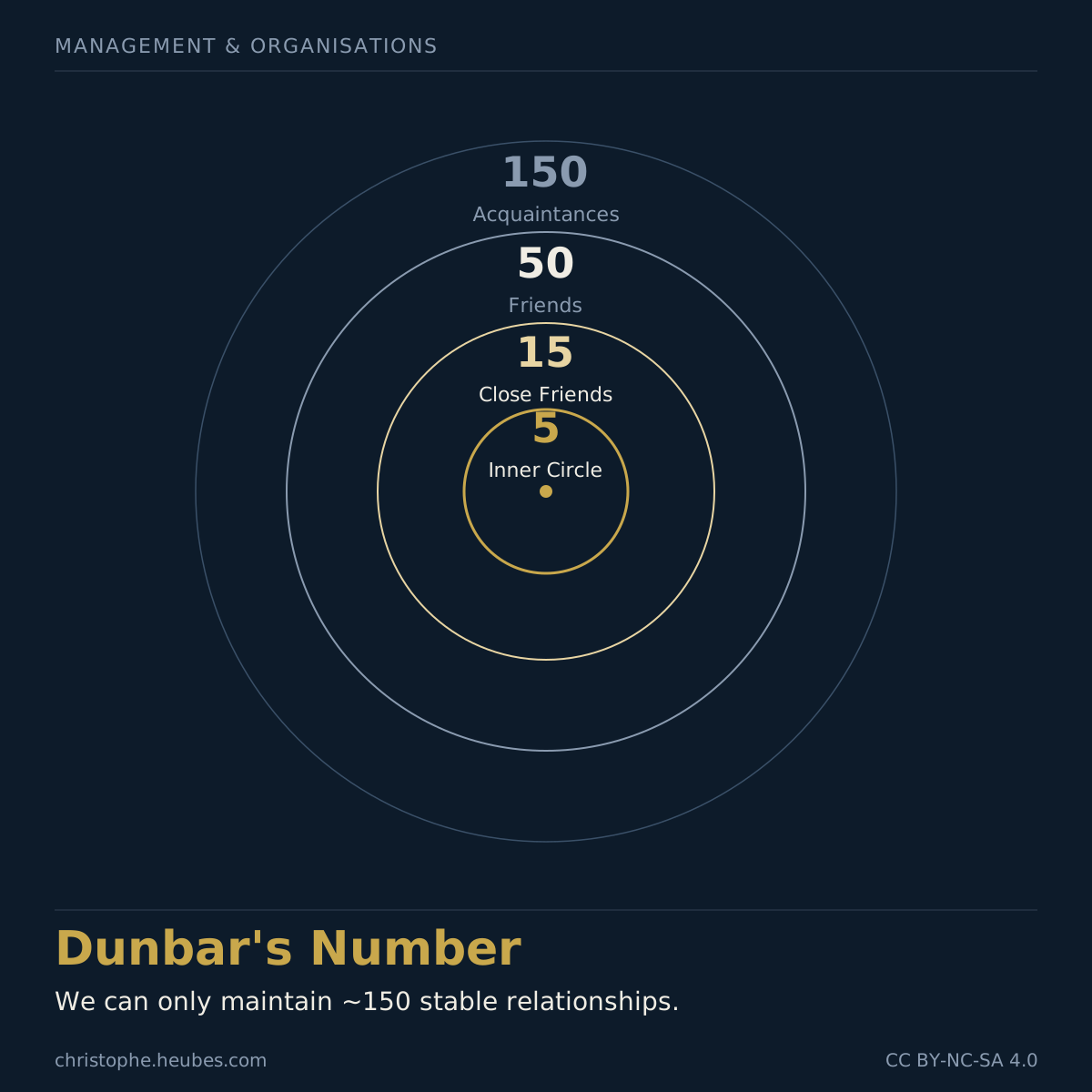
Definition
Anthropologist Robin Dunbar established in the 1990s that the size of the neocortex, the part of the brain involved in social cognition, limits the number of stable social relationships an individual can maintain simultaneously.
This gravitational number is 150 people, organized in nested circles:
| Circle | Size | Characteristic |
|---|---|---|
| Intimate | 5 | Deep emotional support, near-daily contact |
| Close friends | 15 | Strong trust, regular interactions |
| Friends | 50 | Meaningful relationships, frequent contact |
| Acquaintances | 150 | Active social network, tribal cohesion |
Why it matters
This cognitive limit is universal: it appears in the size of military companies, Neolithic villages, and functional units in companies (Amazon’s “two-pizza rule” is an approximation of it).
Beyond 150, organizations need formal hierarchies, written procedures, and explicit controls to function. Below that, direct trust and reciprocity suffice.
Concrete examples
Gore-Tex has a policy of never exceeding 150 employees per production site. When a site reaches this threshold, they open a new one. Cohesion and productivity remain high without heavy formal management.
Social networks: despite having hundreds or thousands of “followers,” studies show that people regularly interact with a core of 100–200 people maximum.
Startups vs. corporations: a 30-person startup runs on conversation and trust. A 500-person company must formalize its processes, not out of bureaucracy, but cognitive necessity.
Knowing Dunbar’s limit means knowing when to stop growing a group and when to start splitting it.